

Syngenta has launched two products for golf courses and other managed turf surfaces. Vertenzo is a systemic fungicide for diseases including dollar spot and microdochium patch, while Rescue II is a selective herbicide designed to remove coarse grasses from fine turf.
The launches give turf managers new options for protecting playing surfaces from disease and restoring swards where unwanted grasses have become established.
Vertenzo targets dollar spot and microdochium patch
Vertenzo introduces prothioconazole as an active ingredient for amenity turf. It offers preventative and early curative activity and is approved for use on managed amenity turf, including golf greens, tees and fairways, as well as stadium pitches and other sports surfaces.
Syngenta technical manager Pete May said warmer conditions were extending the periods in which turf managers faced significant disease pressure. Dollar spot infections are now frequently seen from May to October, while mild conditions can lead to repeated outbreaks of microdochium patch through autumn and winter. May said the two diseases can overlap in autumn, making fungicide choice and application timing particularly important.
“Vertenzo gives a valuable new option to extend all important protection when the risk of damaging disease infection is rising. With the active growing season now extended later into autumn and early winter, there’s greater need for systemic products that can protect turf for longer,” he said.
The fairway approval gives greenkeepers an option for treating dollar spot where it has spread beyond greens and tees. Syngenta says the fungicide moves systemically through the plant to protect new growth and is rainfast within 30 minutes of application, giving turf managers more flexibility when wet weather narrows spray windows.
Two applications are permitted per year. Syngenta says Vertenzo can be used in sequence with Instrata Elite, giving turf managers scope to alternate products during periods of sustained disease pressure. In trials across the UK and continental Europe, the company reports that Vertenzo consistently matched or exceeded the performance of Instrata Elite.
In independent STRI trials in Yorkshire, cultural practices alone reduced dollar spot infection by around 30% compared with untreated turf, although 9% of the surface remained affected. Adding Vertenzo as part of a fungicide programme alongside those practices kept the affected area below 2% throughout the monitoring period.
Vertenzo is supplied as a liquid in 720 ml packs. At the stated application rate of 0.6 litres per hectare, one pack treats 1.2 hectares, roughly the area of greens and surrounds on a typical 18-hole golf course.
Rescue II helps restore fine turf
Rescue II uses the same herbicide technology as the original Rescue in a new formulation designed to improve control of target coarse grasses and increase tolerance in selected turf species. Its approval covers managed areas of golf courses and fine turf sports surfaces, including bowling greens and croquet lawns.
Coarse grasses such as ryegrass and Yorkshire fog can disrupt the smoothness and consistency of playing surfaces. In the rough, dense clumps can make it harder to find and play balls, slowing rounds. May said coarse grasses could spread from adjacent rough and out-of-play areas or persist from former agricultural use. Loss of fairway cover during recent droughts has also given them room to establish in playing areas.
“The chance to selectively remove the unwanted coarse grasses quickly and cost effectively rejuvenates sustainable fine fescue surfaces and allows attractive wispy rough to flourish,” May said.
Syngenta advises turf managers to identify the grasses in their sward before treatment so they can assess how much cover may be lost. The company says fescues and annual meadow grass (Poa annua) are unaffected, while tolerance varies among bentgrass species. May advises trial applications where bentgrass makes up a high proportion of the sward.
Rescue II can form part of a renovation programme that includes overseeding with fescue before treatment and with bentgrass or fescue afterwards. Overseeding helps restore surface quality as the target grasses die back. Syngenta says play can continue during treatment in most cases.
The stated application rate is 0.82 litres per hectare, with a treatment window from March to the end of August. Syngenta advises applying when target grasses are actively growing to aid uptake and movement to the roots. A period of continued growth after treatment also helps the sward recover as the coarse grasses die back.
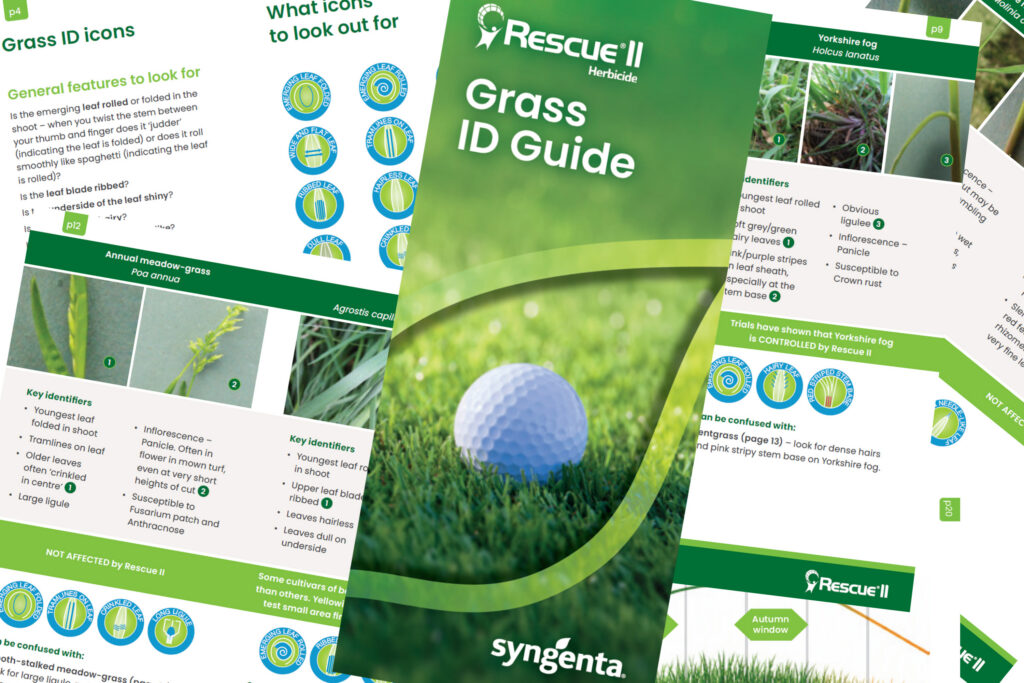
Syngenta is supporting the launch with a grass identification guide, technical guidance and its Turf Advisor dashboard to help turf managers plan application timing. A clubhouse poster and an online Q&A are available to help clubs explain the treatment to golfers and outline what they can expect to see as the turf recovers.
For more details visit Syngenta Turf and Landscape UK