

The European Golf Association (EGA) hosted the European Sustainable Golf Forum at Bernardus Golf during The Solheim Cup week, bringing together key stakeholders from across golf, sport and sustainability.
The two-day event marked another important milestone in golf’s approach to sustainability, with over 80 representatives from more than 30 countries gathering to discuss the environmental and climate challenges facing the game, and to further develop practical, collaborative solutions for the sector. The wider European policy context also featured prominently in the discussions, as Georg Haeusler of the European Commission and Irish MEP Nina Carberry underlined the important role of government in helping drive more sustainable action across sport.
The Forum forms part of wider activities led by the EGA to help coordinate and promote pan-European action on sustainability in golf. Across the programme, discussions focused on some of the most pressing environmental challenges facing the sport, including climate action, nature protection and restoration, water stewardship, sustainable turfgrass management, evolving regulation, data and impact measurement, and credible sustainability communications.
Michael Thannhäuser, EGA General Secretary, said: “Sustainability is one of the most important topics facing golf, both now and for the future. As the representative body for European golf, the EGA has an important role to play in helping national federations work together, share knowledge and respond to the environmental challenges facing the game.
“Through this Forum, we want to support more sustainable approaches to turfgrass and water management, nature restoration and practical action across the sport. By working together, European golf can help shape a more resilient future for the game, while making a positive contribution to the landscapes and communities around us.”
Delegates heard from leading voices across golf, sport and sustainability, with speakers from more than 20 countries, including European government officials, NGOs, representatives from national federations, the Dutch National Olympic Committee, professional tours, and elite athletes.
Alongside golf-specific discussions, the Forum brought in wider perspectives from across European sport, including from Marc van den Tweel, General Director of the Dutch National Olympic Committee, on how golf and other sports can learn from one another, collaborate on nature restoration and reduce their environmental impacts. The role of the European Commission’s Green Sport Manifesto was also highlighted, providing a useful framework for sports organisations seeking to act in a more environmentally conscious and coordinated way.
The programme included several important developments and areas of focus for the European golf sector, including:
- Preview of forthcoming Sustainable Golf Knowledge Centre, a central, open-source platform bringing together scientific data, guidance, case studies and grassroots examples from around the world
- Insights into the forthcoming Sustainable Golf Review, a joint R&A and GEO Sustainable Golf Foundation report bringing together sustainability data, knowledge and leadership examples from across golf
- Examples of leadership from national federations, professional tours and grassroots facilities, including the European Tour Group Green Drive and the Dutch Golf Federation Sustainability Covenant
- Presentation of wider research and strategies, including the European Golf Water Stewardship and Turfgrass Roadmap
A key facilitator of the event was Richard Holland, formerly of WWF and Wetlands International, and member of the advisory groups of the GEO Sustainable Golf Foundation and the Dutch Golf Federation:
“It is encouraging to see the golf sector’s work in sustainability start to accelerate and deepen, given the pace and scale of the nature and climate crises we face.
“Without action, golf is at risk of going extinct in various regions. With effective action, golf can contribute in a meaningful way to biodiversity conservation, better land and water management, and towards a net positive impact on climate.
“Among all sports, golf has a unique opportunity to bring people into contact with their local environment, enabling the sport to build understanding and support to safeguard the natural world”,said Holland.
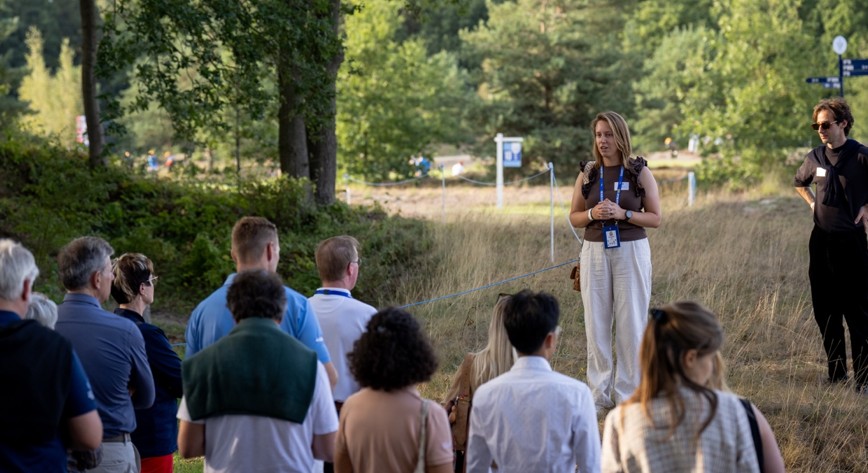
Delegates on an evening nature walk around Bernardus Golf, hosted by the Dutch Golf Federation
Additional Voices from the Forum
Further reflections from speakers, participants and partners included:
Georg Haeusler, Director, Directorate-General for Education, Youth, Sport and Culture, European Commission, said: “I think golf has understood the message of our times: that you can only continue with your activity, particularly when you are as present in the landscape as golf is, if you adhere to certain principles. Environmental sustainability is certainly one of those principles. The sport can really make a difference if courses become sources of biodiversity and green lungs close to cities.”
Celina Sattelkau, Professional Golfer and Ladies European Tour (LET) Sustainable Golf Champion, added: “I have always loved the connection between golf and nature and believe I have a responsibility to use my platform to encourage positive change – socially and environmentally. There are many organisations doing valuable work to drive this movement in sustainable golf forward – and raising wider awareness and inspiring a wider audience is an important element that I am proud to support.”
Alexander de Vries, Sustai ability Manager, Royal Dutch Golf Federation mentioned: “For decades, golf courses have been enhancing biodiversity and reducing their environmental footprint. Not because they have to, but because they recognise their responsibility. Golf is played in nature, and that gives us a unique opportunity to protect and restore it. By working together, we can show how our sport can be a force for positive environmental change.”
By convening stakeholders from across the game and beyond, the Forum supported greater coordination, shared learning and practical action across European golf.
The event also underlined the role golf can play in contributing to wider environmental goals, while helping clubs, federations, tours and facilities prepare for the challenges and opportunities ahead.